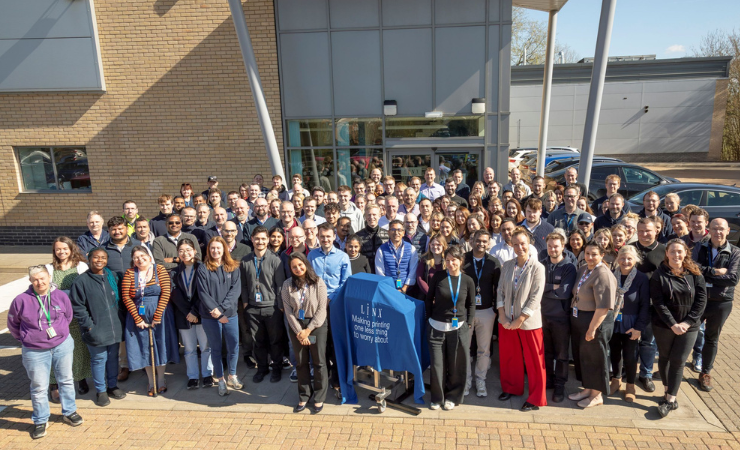
Linx Printing Technologies is set to highlight a new continuous ink jet (CIJ) printer range at this year’s interpack 2026 in Düsseldorf.
The new CIJ range will form the centrepiece of the company’s presence and will be presented alongside its existing portfolio of coding and marking technologies. These include laser coding systems, thermal transfer printers and large character marking solutions, reflecting Linx’s focus on developing products aimed at improving efficiency and usability in production environments.
Linx will also preview a new model in its large character marking printer range, ahead of a planned launch later in the year. The system is designed for printing text, logos and graphics directly onto porous materials such as cardboard, paper and wood, with applications across manufacturing, packaging and logistics sectors.
The company’s laser coding portfolio will also be featured, with three models demonstrating a range of capabilities for different materials and production requirements. These systems offer permanent, high-speed marking without the need for consumables, which can help reduce operating costs.
Among them, the Linx UVG5 is designed for use on delicate mono-recyclable films and rigid plastics, while the CSL30 model is suited to marking materials such as glass and rubber on high-speed lines. The CSL30 incorporates a CO₂ laser marking head with integrated focus technology, allowing adjustments without repositioning the unit, which can reduce changeover times.
The fibre laser model, FSL20, is intended for applications requiring high precision, such as marking small components or adding detailed information in limited spaces. It is positioned for use in sectors including pharmaceuticals, medical devices, automotive and electronics, where traceability is important.
In addition, Linx will present three thermal transfer printer models capable of printing on flexible packaging materials such as bags, pouches and labels. These systems feature a range of ribbon options and user-focused design elements, including touchscreen interfaces and simplified cartridge systems, to support ease of operation and maintenance.
According to the company, the exhibition provides an opportunity to introduce what it describes as a significant development in coding and marking technology, particularly for high-demand production settings.