
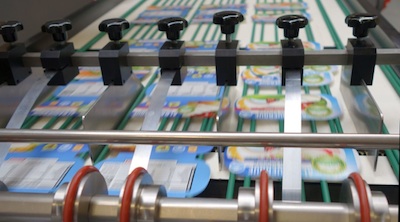
The latest company to invest in Xeikon technology for in-mould labels is IML Labels. The Canadian company has added a Xeikon 3500 digital colour press to complement its offset presses.
‘Our customers are spread throughout North America and about 75% of them are involved in the food business,’ said owner Donald Caron, who founded IML Labels in 2007. ‘As a result, it was very important to us that the Xeikon toner is FDA compliant for food contact and does not contain mineral oil. In addition, color matching with our offset presses is so accurate that we can mix both processes within the same job.’
IML Labels has grown rapidly since its formation and today it employs more than 50 people. The company provides a comprehensive ‘one-stop shop’ service including pre-press, overprinting and finishing in order to create high quality, ready-to-mould labels. Typical end products are ice cream containers, yogurt pots and butter tubs. Its client base includes moulders and direct customers, many of whom are leading names in the food sector, as well as pharmaceutical, industrial and souvenir industries.
‘We are being asked frequently to provide mock ups and help with test marketing new packaging. In addition, we are experiencing a growing demand for shorter print runs, often down to around 1000. Our offset presses simply weren’t economical for these orders. The Xeikon 3500, already in operation on a full shift basis, enables us to meet these requirements effectively and provide a better service to our customers.’
The new press at IML Labels runs ICE toner, which is now the standard toner for printing in-mould labels, and can handle substrate widths up to 516 mm. The company has also installed a UCoat finishing unit, which allows inline flood aqueous coating and provides cut-to-sheet capabilities. Die-cutting of labels is done on existing equipment used for offset printed labels.
‘The Xeikon 3500 has proved to be the ideal sales and marketing tool,’ said Mr Caron. ‘Orders from new customers are printed digitally as these invariably involve shorter runs. Consequently, we have eliminated the waste and inefficiencies we used to encounter on our traditional presses. When orders reach a certain size, they can easily be switched to offset.’
He added, ‘We intend to take advantage of the ability to print variable data on the digital press to incorporate features such as sequential numbering. Today, the market is demanding a level of production flexibility that only digital printing can provide. However, every situation is different and we worked closely with Xeikon to develop a solution that met our specific requirements.’