New research from Smithers forecasts continued expansion for the global inkjet printing industry, with strong growth expected through to 2031 as packaging demand, sustainability pressures and advances in AI reshape the market.
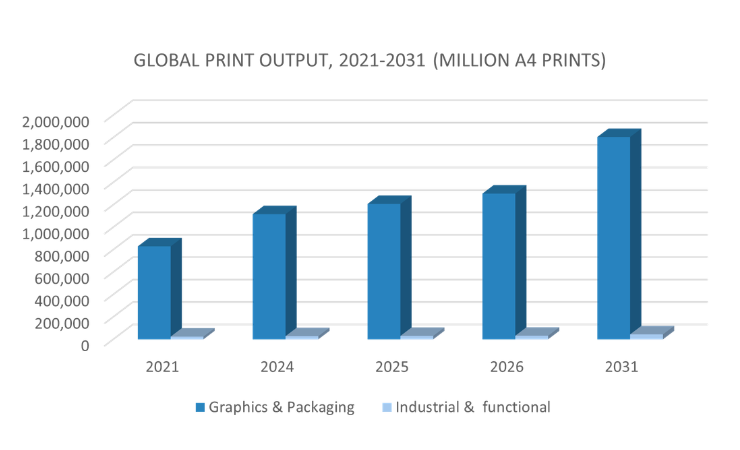
According to the company’s report, “The Future of Inkjet Printing to 2031”, the graphic and packaging inkjet sector will be worth $101.1 billion (£74.2 billion) in 2026, with output volumes growing at a compound annual growth rate of 6.9% and market value rising by 9.4% annually. The smaller industrial and functional inkjet segment is projected to add a further $29.2 billion (£21.4 billion) in 2026.
By 2031, Smithers expects the graphic and packaging market to reach $134.6 billion (£98.8 billion), while industrial and functional inkjet will climb to $42.7 billion (£31.3 billion). Growth is being driven by shifts in geography, technology, ink chemistry and equipment design.
Asia Pacific is emerging as the industry’s dominant region, with China and India increasingly influential as both consumers and manufacturers of inkjet systems and consumables. The report says the region is expected to surpass North America across all key metrics by 2031, intensifying competition for Western manufacturers.
Packaging and labels are forecast to deliver the fastest growth as e-commerce, personalised printing and shorter production runs fuel investment. At the same time, demand for advertising and transactional print continues to decline.
Smithers also highlights sustainability and automation as major drivers of change, with water-based inks, predictive maintenance and AI-powered workflow tools expected to become standard features across the industry by the end of the decade.
In another recent report, Smithers highlights barrier coatings continue to dominate the global packaging coatings market, while water-based and specialty coatings are expected to deliver the strongest growth through to 2031.
Th report, “The Future of Packaging Coatings to 2031”, suggests that the global market will be worth almost $15.4 billion (£11.3 billion) in 2026. Barrier coatings account for the largest share, representing demand of 4.4 million tonnes valued at $9.97 billion (£7.3 billion) in 2025.
Extrusion coatings currently make up 33.4% of global packaging coating volumes, with polyolefins accounting for more than 63% of demand. However, Smithers forecasts the fastest growth will come from water-based coatings and vacuum deposition technologies as regulators and brand owners seek more sustainable alternatives.
The study highlights the impact of new European regulation, including the EU Packaging and Packaging Waste Regulation (PPWR) and Single-Use Plastics Directive, which are accelerating demand for recyclable and circular packaging solutions.
Robert Outram, Smithers consultant and co-author of the report, said coatings are becoming critical to whether packaging formats can meet tightening recycling requirements. He added that innovation is essential as traditional materials come under increasing pressure.
Solvent-based coatings, historically dominant in flexible packaging and foil applications, are continuing to lose market share to water-based and radiation-curable systems. While performance challenges remain, particularly on plastic substrates, adoption is increasing rapidly.
Food packaging remains the largest end-use sector globally, followed by beverages, while pharmaceuticals and healthcare are forecast to be the fastest-growing applications to 2031 due to rising demand for high-performance sustainable packaging.