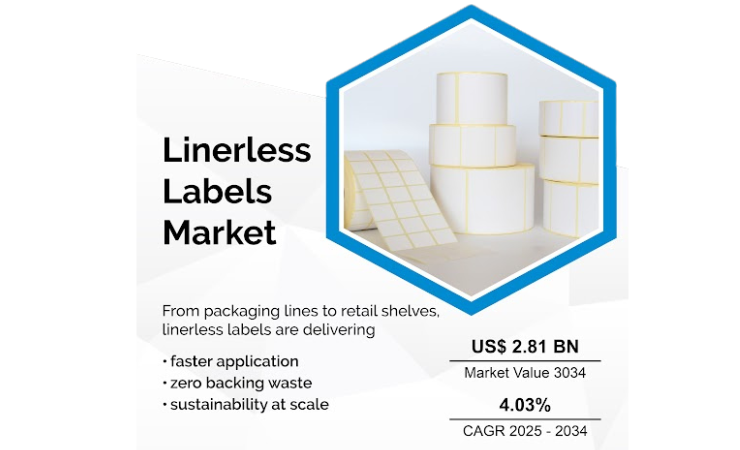
The global linerless labels market is expected to grow over the next decade, reaching a value of $2.81 billion (£2.14 billion) by 2034, according to a report by Polaris Market Research.
The market stood at $1.9 billion (1.44 billion) in 2024 and is projected to grow at a compound annual growth rate (CAGR) of 4.03% between 2025 and 2034. This growth is being driven by increasing demand across industries for sustainable labelling solutions that minimise waste and improve productivity.
The adoption of linerless labels is being influenced by a combination of operational and environmental factors, suggests the research. As businesses seek to reduce their environmental footprints and comply with sustainable packaging regulations, linerless labels offer a practical solution. Their liner-free construction cuts down on paper consumption and eliminates the need for liner disposal, helping companies lower material use and waste-related costs. These labels are also compatible with thermal printing technologies, making them suitable for sectors such as logistics, food packaging, retail, and manufacturing.
Polaris Market Research identifies the Asia Pacific region as a key area of growth for linerless labels, driven by rapid industrialisation and expansion in end-use industries such as food and beverage, healthcare, and e-commerce. The report also highlights growing demand for hot melt-based adhesives, which are known for their quick setting times and strong adhesion on rough or uneven surfaces. These adhesives are commonly used in automated labelling systems, particularly in warehousing and logistics operations.
Linerless labels are categorised by the type of adhesive they employ. Water-based adhesives, composed of polymer and water emulsions, are valued for their low volatile organic compound emissions and are typically used in general-purpose applications. Solvent-based adhesives, made by dissolving polymers in organic solvents, offer high durability and are used in environments where moisture, oil, or extreme temperatures are factors. Hot melt adhesives, which become tacky when heated, are suited for high-speed applications and perform well in temperature-sensitive settings. Additionally, UV curable adhesives, which harden when exposed to ultraviolet light, are used in specialty applications requiring high chemical resistance and clarity.
While no single factor dominates market growth, the report underscores a combination of drivers. These include corporate sustainability goals, rising demand for clean and efficient labeling solutions in food and retail, and the broader shift toward automation in packaging operations. As labeling requirements become more complex and environmentally focused, linerless labels offer a versatile and increasingly adopted solution.