Adoption of connected packaging technologies has increased significantly over the past year, with most industry participants expecting the technology to become even more important, according to new global research.
The fifth annual “Global Connected Packaging Survey 2026”, released by Appetite Creative in partnership with Koenig & Bauer Auraveo found that 92.3% of respondents believe connected packaging will grow in importance over the next 12 months and beyond, up from 88.8% in 2025.
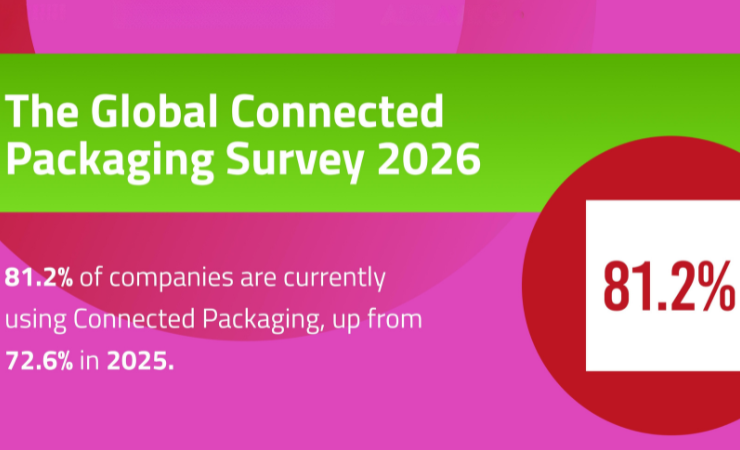
The share of companies using connected packaging has also risen, with 81.2% reporting current adoption compared with 72.6% last year. Respondents cited data collection (60.9%), regulatory compliance such as GS1 standards and digital product passports (60.7%), sustainability (60.4%), marketing and customer loyalty (60.2%), and consumer engagement (57.8%) as key drivers.
The survey also found a continued shift toward combining multiple technologies rather than relying on a single solution. QR codes and NFC tags used together are now deployed by 47.1% of adopters, compared with 31.8% using QR codes alone and 21.1% using NFC alone. Interest in serialised QR codes increased to 73.2%, up from 66.1% in 2025, while scepticism declined, with only 7.7% of respondents describing connected packaging as a passing trend, down from 13.4% the previous year.
Adoption was highest in the marketing and advertising sector (14.2%), followed by automotive and travel (13.5%), manufacturing (13.5%), FMCG (12.4%), and packaging (12.4%), indicating broader uptake beyond traditional packaging industries.
The report highlighted that investment in digital marketing remains strong, with 75.7% of respondents increasing their digital marketing spend in 2026, broadly in line with 75.5% in 2025. Campaign planning has risen to 83.3%, compared with 76.7% last year. Budget allocations are shifting upward, with fewer organisations planning to spend less than $15,000 and more reporting higher spending ranges, including 15.3% expecting to spend between $51,000 and $80,000 (£37,000 – £59,000), up from 10%, and 13% reporting budgets above $81,000 (£60,000), compared with 7.7% last year.
The use of gamification in connected packaging campaigns has expanded, with 67.7% of respondents incorporating game-based elements, up from 59% in 2025. Mobile games (52.1%), quizzes and trivia (48.9%), and augmented reality games (42.3%) were the most common formats. The primary objective was promoting new products or services (47.2%), followed by gathering consumer insights (23.4%) and increasing brand awareness (17.7%).
Jenny Stanley, managing director at Appetite Creative, said: “Five years in, and the data tells a compelling story. Connected packaging has moved decisively from an emerging trend to a boardroom imperative. The record adoption rates, surge in gamification and the increasing focus on regulatory compliance all point to an industry that is no longer just experimenting, it’s implementing at scale. What is particularly exciting is how the use cases are broadening: from consumer loyalty and sustainability to supply chain traceability and digital product passports. Connected packaging is no longer a marketing tool alone; it is a strategic business platform.”
Sandra Wagner, CEO of Koenig & Bauer Kyana, added: “Connected packaging has reached an inflection point, and the results of this year’s survey make that unmistakably clear. The record adoption rates, the surge in multi-technology deployment and the growing focus on regulatory compliance all reflect an industry that has matured significantly.”