
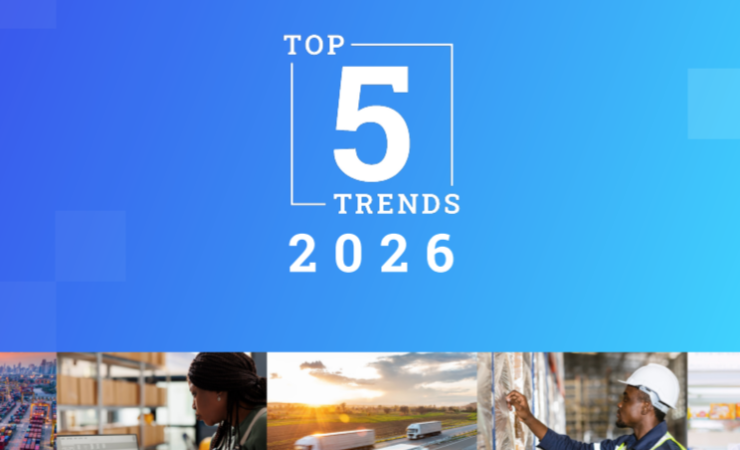
Loftware, provider of cloud-based label management solutions, has released its 2026 Top 5 Trends Report, revealing that businesses are urgently modernising their supply chains in the face of increasing regulatory demands.
Drawing on insights from more than 400 supply chain professionals across 55 countries, the report highlights a decisive shift toward connected supplier networks, real-time packaging intelligence, and AI-enabled automation as organisations work to strengthen resilience and stay competitive in an unpredictable global landscape.
“The future of supply chains will be defined by agility and intelligence,” said Jim Bureau, president & CEO of Loftware. “Our research shows that organisations adopting connected networks, cloud platforms, and AI-driven insights are not just surviving disruption but turning it into opportunity. By modernising today, companies can anticipate challenges, act in real time, and create supply chains that are smarter, faster, and ready for whatever comes next.”
The research underscores how volatility has become the defining feature of today’s supply chains. Yet many organisations remain unprepared: according to Gartner data, only 29% of companies are ready to manage the next wave of supply chain challenges. At the same time, financial pressure is intensifying. Among companies surveyed with a revenue of $1 billion or more, 50% expect tariffs or trade restrictions to cost them over $1 million in the coming year, with nearly one in five anticipating an impact exceeding $10 million.
According to the report, companies are responding by accelerating investment in solutions that unify supplier ecosystems, ensure consistent and compliant product data, and reduce the operational friction caused by siloed processes. Nearly 70% of respondents believe that sharing label data and standards with trading partners would help them respond faster to disruptions; an indication that the industry is moving quickly toward more collaborative and connected networks. Organisations that have already adopted such models report measurable gains, including 48% citing faster problem resolution and 37% citing reduced operational costs.
The findings also reveal that geopolitical uncertainty is forcing businesses to rethink compliance strategies. Many organisations still struggle to adapt product data and labelling processes to new tariffs or regulatory changes, with 63% of $1B+ companies calling these adjustments “very” or “somewhat difficult.” As supply chains move through reshoring, nearshoring, and multi-sourcing, cloud-based labelling is essential for accuracy and compliance across shifting supplier networks, helping companies avoid costly delays, border holds, and penalties.
Consumer expectations are driving transformation as well. Smart packaging, powered by real-time label data, dynamic QR codes, and connected product information, is emerging as a critical tool for improving engagement, sustainability, and operational efficiency. According to the research, 91% of respondents believe real-time label data helps reduce waste, errors, and improves efficiency. Companies view enhanced traceability (64%) and improved consumer engagement (44%) as the top benefits of connected packaging, illustrating how brands are beginning to treat packaging not just as a regulatory requirement, but as a strategic channel for data, transparency, and customer experience.
Authenticity and traceability are now essential in modern supply chains, accelerated by initiatives like Digital Product Passports and next-generation 2D barcodes. With consumers, regulators, and trading partners demanding verifiable product information, 88% of respondents say cloud-based product identification platforms establish a single source of truth to ensure accurate tracking, traceability, and authenticity. The research illustrates that strengthened traceability improves compliance (43%), visibility (40%), audit readiness (34%), and counterfeiting protection (27%).
Loftware’s report shows that autonomous supply chain technologies are gaining traction. Powered by SaaS-based labeling platforms, AI analytics, and integrated data, these systems help detect disruptions earlier, optimise logistics in real time, and automate error-prone processes. Seventy-five percent of respondents use SaaS-based labelling for resilience, citing benefits like higher efficiency (41%), fewer errors (37%), lower waste (33%), and faster response (30%). As companies face greater complexity across supplier networks, these capabilities will play a central role in building supply chains that are not just connected, but intelligent and self-optimising.