In its latest report, research consultancy Smithers forecasts that the barrier coating market will grow at a compound annual growth rate (CAGR) of 4.8%, reaching 4.6 million tonnes and a value of $11.7 billion (£9.13 billion) by 2030, based on constant pricing.
The report, “The Future of Sustainable Barrier Coatings to 2030”, examines current and forecast demand for coatings that deliver effective barrier properties while improving recyclability, biodegradability, or the use of bio-based materials.
Global consumption of barrier coatings is projected to reach 3.7 million tonnes in 2025, with a total market value of $9.2 billion (£7.18 billion), the report stated.
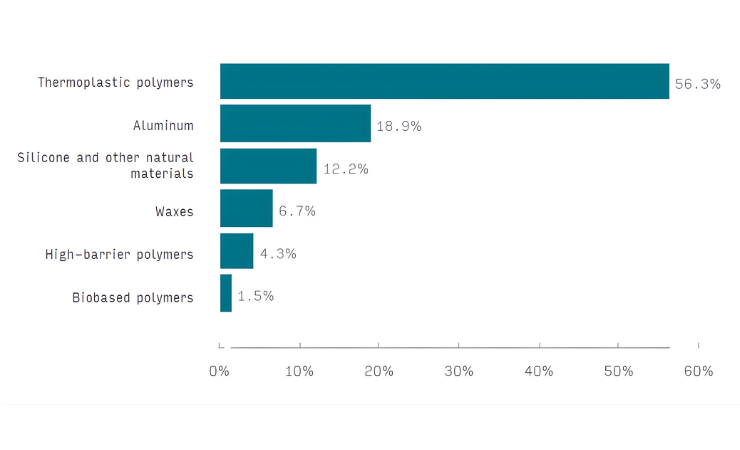
According to the research, polymers and metal foils continue to dominate the market, with thermoplastic polymers accounting for 66% of global demand. Thermoplastics are expected to retain this share over the next five years, supported by wider adoption of water-based coatings. Aluminium barriers are also forecast to see greater use, while waxes, high-barrier polymers, and silicone coatings are likely to decline.
The fastest-growing segment will be bio-based coatings, projected to rise at a CAGR of 25% – from $146.4 million (£114.2 million) in 2025 to $446.8 million (£348.5 million) in 2030. These materials are being developed to meet brand owner demand for renewable and biodegradable options. Growth will be driven by coatings such as bio-based polyethylene, polylactic acid, and new biodegradable polymers.
Sustainable barrier coatings are expected to play a growing role in sectors such as paperboard packaging, where producers are seeking alternatives to rigid plastics, the report stated. Folding cartons are forecast to remain the largest users of bio-based coatings, though corrugated materials are also expected to gain share.
The report also highlighted that opportunities are strongest in food and food-service packaging, where improved coating performance will support the shift away from single-use plastics.
Technical advances and new regulations are also expected to accelerate adoption. In Europe, forthcoming design-for-recyclability criteria under the Packaging and Packaging Waste Regulation are likely to favour easier-to-recycle coating systems. Meanwhile, extended producer responsibility schemes are creating financial incentives for companies to invest in newer, more sustainable coating technologies.