
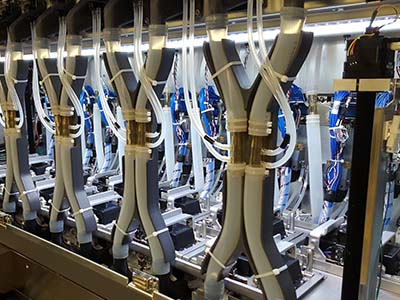
Array of 12 Stream printheads in wide Prosper print unit (note the air blowers that recirculate unused drops)
As Kodak celebrates its 50th anniversary in the inkjet business and announces the first user of the Prosper 6000S press, Sean Smyth visited the company’s Dayton (Ohio) home to get an update on its high-speed plans for the packaging sector.
Kodak began manufacturing inkjet printing systems at its impressive Dayton facility in Ohio back in 1967, and is proudly celebrating its 50th (yes, 50 years) birthday this year. Dayton is a hotbed of invention, home to the Wright Brothers who pioneered flight, while car ignition systems, cash registers, LCD displays and the US Navy’s cryptographic Bombe (the US version of the Enigma machine) were all invented there. The city hosts a fabulous museum of invention celebrating how Dayton changed the world, complete with a 1930s letterpress printshop, which was a pleasure in itself. Kodak is soon to be inaugurated there with an exhibit showcasing its inkjet innovation.
The Prosper inkjet division was up for sale last year, but the decision was made to keep the $170 million group as part of Kodak, forming the Enterprise Inkjet Systems Division (EISD), which is one of seven divisions making up the new Kodak. Chief financial officer Dave Bullwinkle outlined the financial performance, showing the future will be of strong growth and cash generation as the existing Stream technology continues and the company introduces the new, very high quality Ultrastream inkjet systems over the next years.
The CEO of the group is Randy Vandagriff. He came from the engineering side of the company and is very positive about the future, highlighting the opportunities for inkjet in packaging as a key market going forward.
First Prosper 6000S user
The company has developed the Prosper 6000S press, a simplex web-fed four-colour machine that can run at speeds up to 300m/min, at high ink coverage, printing the equivalent of 12,000 B1 sheets an hour.
One of the first users will be Cincinnati-based Zumbiel Packaging, which produces high volumes of cartons and sleeves on flexo and sheetfed litho presses. It has installed the press configured as a hybrid webfed line with two flexo units before the inkjet and five after, into a die-cutter to deliver finished carton blanks. The flexo units will print static heavy coverage areas, allowing the inkjet to print high quality graphics and variable content.
The company supplies to the beverage market, cases and trays of soft drinks and beers. Owner Ed Zumbiel is passionate and enthused with the potential of high volume cost-effective digital production and has ordered two machines, although the configuration of the second line has not yet been finalised. He is the first converter I have heard who publicly says the cost of consumables, ie inkjet ink, is ‘low’!
Another hybrid press using the same print engine will be launched later this year by Uteco; the Sapphire EVO digital press for flexibles, again on a 650mm wide web with top speed over 150m/min. Uteco has customers signed and will be running public demos in November this year. Interestingly both systems will use the same water-based ink that is certified to conform to the Nestlé guidelines for food applications. Kodak has developed what they call an optimiser, applying a light coating of primer onto the surface – paper, board or film – that immobilises the ink at printing stage to optimise the print quality on any litho or flexo substrate.
Kodak said it has some 150 imprinting heads mounted onto packaging lines to add variable data to packs; on presses and finishing lines printing items as diverse as loyalty codes for Chinese cigarettes, or coupons on baguette bags in Paris (the latter drawing a 25% response rate).
Going ultra
For the future, the even higher quality Ultrastream technology has been refined. This is a continuous inkjet mechanism; the heads and mounting systems deliver smaller drops from a more compact print module, using the same inks as the Stream technology. Heads can be stitched into arrays up to 2.48m wide and systems will print up to 150m/min. It will cost over $50 million to bring this technology to market and Kodak is following a strategy of partnering with press manufacturers to develop solutions, rather than building presses itself. As such the details of potential machines are sketchy, but there are 19 partners already signed up. Packaging is very firmly on the agenda. Uteco is one partner, but Kodak will not be drawn on the identity of others. Expect to see new generation machines next year.
After several very trying years, it is good to see such a pillar of printing technologies back on an even financial keel. The inkjet business was the first to market a full colour single pass press back in the last century, and it is firmly committed to providing high quality, high productivity machines that compete with mainstream litho and flexo presses, for high volume jobs. It is also reducing the cost of inkjet printing to win market share, which was one of the main plus points for Ed Zumbiel in his decision to buy two new carton presses.
So, happy birthday, Kodak, and here’s to the next 50 years. You’ve got a lot of pedigree to live up to.